Overblog Tous les blogs Top blogs Littérature, BD & Poésie
Suivre ce blog Administration + Créer mon blog
MENU

Dans " La mémoire tatouée ", Abdelkébir Khatibi subvertit le réel en le tressant au rêve, au fantasme et au drame, d’où l’enchâssement de plusieurs genres dans le roman (essai, poésie, théâtre). Essai... "> Vie polymorphe

Publié le par Doctor S.F

UN COURANT LITTERAIRE ... " Résumé de l'article => Dans " La mémoire tatouée ", Abdelkébir Khatibi subvertit le réel en le tressant au rêve, au fantasme et au drame, d’où l’enchâssement de plusieurs genres dans le roman (essai, poésie, théâtre). Essai et roman mettent en scène l’aliénation du colonisé et d’une génération entière, déracinée, et donc rivée à un double langage. La tentative du je consiste à représenter l’intellectuel colonisé pour s’insurger contre sa propre aliénation. L’autobiographie se dit par éclatement et par cris. Son analyse nécessite une bonne connaissance de la trajectoire de l’auteur afin de situer la prise de parole de l’écrivain dans le cadre de sa deixis sociale. Le présent article examine donc le parcours intellectuel de Khatibi en matière de dispositions, de positions et de prises de positions en vue de saisir le portrait autobiographique tel que transfiguré par l’auteur et par la tricherie de l’écriture. " Hél-Bongo, O. (2012). Polymorphisme et dissimulation du narratif dans La mémoire tatouée d’Abdelkébir Khatibi. Études littéraires, 43, 45–61. Polymorphisme et dissimulation du narratif dans La mémoire ...

=> Polymorphisme et dissimulation du narratif dans la mémoire

... UNE EXPERIENCE LITTERAIRE Type(s) de contenu et mode(s) de consultation : Texte noté : sans médiation Auteur(s) : Fuchet, Serge Voir les notices liées en tant qu'auteur Titre(s) : Vie polymorphe [Texte imprimé] / Serge Fuchet Publication : Paris : les Éd. du Panthéon, 2001 Impression : 27-Verneuil-sur-Avre : Impr. J.-C. Lavielle Description matérielle : 93 p. ; 20 cm Numéros : ISBN 2-84094-677-7 (br.) : 64 F : 9,76 EUR Identifiant de la notice : ark:/12148/cb376541924 Notice n° : FRBNF37654192

A propos de la publication VIE POLYMORPHE


Vie polymorphe

Voir les commentaires

Libres propos de Jean-Yves Tadié sur Marcel Proust

Publié le par Patchwork

Proust et la société – Entretien avec Jean-Yves Tadié. 


Professeur émérite de Littérature à l’université Paris-Sorbonne (Paris IV), Jean-Yves Tadié est un éminent spécialiste et biographe de Marcel Proust auquel il a consacré de nombreux ouvrages ainsi que l’édition de La Recherche pour la Bibliothèque de la Pléiade. Il a publié Proust et la société aux Éditions Gallimard.


NP – Vous publiez Proust et la société, aux Éditions Gallimard, deux ans après un recueil de textes intitulé Marcel Proust. Croquis d’une épopée qui rassemblait dix ans de critique proustienne et a été couronné du prix Céleste Albaret 2020. Que souhaitez-vous ajouter avec ce nouveau livre ?

JYT – J’avais abordé des sujets très divers dans Croquis d’une épopée – Baudelaire et Lionel Hauser, un prince monégasque et une mystérieuse voisine du boulevard Haussmann, des promenades et des découvertes -, alors qu’ici j’ai souhaité parler du monde social de Proust et de sa vision de la société. J’ai conçu mon plan en m’appuyant sur les relations sociales telles que Proust les connaissait ou les réinventait à sa manière : la sociologie, la géographie, la psychologie, l’histoire.

Dans mes ouvrages précédents, je m’étais soucié de biographie, de forme ou de psychanalyse, étudiant les circonstances, la musique, la peinture ou les jardins. Ici, c’est un sujet neuf que je n’avais encore jamais abordé de cette manière.



NP – Dites-vous en substance que Proust a écrit la Comédie humaine du XXe siècle comme Balzac a écrit la Comédie humaine du XIXe siècle ?

JYT – J’ai voulu montrer que les très grands romanciers écrivent toujours une Comédie humaine. Il y a Balzac bien sûr mais aussi Proust qui n’est pas seulement le romancier de l’individu, celui qui a créé cinq cents personnages, mais le romancier des classes sociales et des groupes sociaux. Ses personnages sont systématiquement intégrés à des clans, voire des tribus. C’est donc un peu la même chose à des époques différentes. Il est vrai que Balzac traite un problème particulier dans chacun de ses romans, comme les paysans ou la vie politique, ce qui rend son œuvre plus divisée. Elle est aussi beaucoup plus longue – elle doit faire le triple en longueur de celle de Proust. Balzac a une vue immense et il a traité davantage de problèmes sociaux que Proust qui préfère échafauder de grandes structures, applicables à d’autres groupes que ceux dont il parle.


NP – Vous vous attardez un chapitre sur les domestiques en tant que personnages littéraires puis en rêvant qu’ils auraient eux-mêmes pu narrer la Recherche :

« Eulalie et Françoise racontent leur Combray ; Françoise persécute la fille de cuisine ; le cocher Lorédan retracerait les errances de Swann, celui des Verdurin, des Cambremer la vie de leurs maîtres. Le personnel du Grand Hôtel de Balbec raconterait la vie au bord de la mer : le liftier, le maître d’hôtel ; les valets de l’hôtel louche de Jupien dans Le Temps retrouvé les orgies pendant la guerre et ceux du prince de Guermantes la matinée finale du roman ».

JYT – En s’intéressant aux domestiques, Proust ne fait que refléter la réalité sociale de son époque. Il y avait un million de domestiques en France en 1900 : c’est un groupe considérable. Même la petite bourgeoisie moyenne avait alors des employés de maison. La famille de Proust employa jusqu’à cinq personnes qui ont servi de modèles à l’écrivain. Il crée dans son roman les figures de Françoise et d’Eulalie. Une cuisinière à Paris prépare des plats délicieux pour le Marquis de Norpois et Françoise, dans un rôle très maternel, entoure le Narrateur jusqu’à la fin de l’œuvre, l’accompagnant de son savoureux langage et de ses interventions dans le récit. Il y a aussi Aimé au Grand Hôtel de Balbec qui se meut en agent de renseignement du Narrateur et part enquêter sur Albertine. Les domestiques jouent toutes sortes de rôles – ce n’est pas nouveau, le théâtre les utilisait déjà beaucoup, souvent comme confidents. Ils sont issus de milieux populaires et Proust peut noter à loisir leurs tours de phrase et le parler du terroir. Il ne connaît pas les milieux ouvriers et ne procède pas à des enquêtes. Il recueille ce qu’il a sous la main dans sa vie personnelle et les employés d’hôtels sont des sources importantes, comme Olivier Dabescat au Ritz.


NP – Dans la partie traitant de la géographie, vous évoquez les hôtels fréquentés par Proust, avec lesquels il entretient une relation faite à la fois de méfiance et de fascination.

JYT – Parmi les hôtels de Proust, il faut distinguer ceux dans lesquels il part en vacances et ceux qu’il fréquente à Paris. Ces grands hôtels du XXe siècle sont fascinants pour l’écrivain car c’est un véritable monde, une société en abrégé où aristocrates et bourgeois se retrouvent mêlés avec le personnel de l’établissement et les touristes étrangers. C’est un lieu idéal pour un observateur comme Proust, avec ses clivages sociaux et ses différentes manières de vivre. Pendant la guerre, Proust se rend au Ritz pour assister aux réactions des clients de l’hôtel.

  Dans ce registre, il faut encore compter les maisons de passe, un thème littéraire récurent du XIXe siècle avec Zola et Maupassant. On le trouve dans Du côté de chez Swann puis avec les descriptions des maisons pour femmes et des maisons pour hommes, jusqu’aux scènes du Temps retrouvé avec Jupien et Charlus.

  Proust s’intéresse aussi à la solitude de la chambre inconnue. C’est un thème sociologique important qu’on rencontre dans les Jeunes filles et Le côté de Guermantes, mais aussi dans Du côté de chez Swann avec l’angoisse du héros dans sa chambre les premiers soirs et la scène du baiser qui est le grand thème de Combray. La chambre est inquiétante puis rassurante et il ne voudra finalement pas la quitter.


NP – Vous consacrez un long chapitre à Paris, avec entre autres une analyse sur ce passage des cris de Paris devenu un véritable morceau classique et une réflexion sur le Paris du Temps retrouvé qui, « grâce à la matinée de la princesse de Guermantes », « récapitule tout, les villes, les campagnes, la mer, l’Orient et l’Occident, Venise : « Ô métamorphose mystique / des espaces fondus en un ! », pourrait-on dire en déformant Baudelaire ».

JYT – Proust est éminemment parisien et son Paris est celui des beaux quartiers. Celui du 8e arrondissement autour de saint Augustin, qui était à l’époque très vivant et peuplé, et le Paris de l’aristocratie, ce Faubourg Saint-Germain immatériel, qui se déplace. On quitte ainsi le 7e arrondissement pour le 16e et le 8e qui en sont des pastiches. C’est le Paris des promenades au Bois de Boulogne, le Paris qui ne travaille pas et cède au rituel des promenades en calèches qui seront peu à peu chassées par l’automobile après la guerre.

  Il existe aussi un Paris misérable, comme dans ce passage frappant de la cour de l’hôtel de Guermantes où Proust évoque « Toute une moitié de l’humanité [qui] pleurait ». Il y a quelques mentions de rues dans l’est parisien mais pas beaucoup. L’ensemble est très concentré, Proust ne cherchant pas à donner une vision globale de Paris avec tous ses quartiers. Ainsi, Auteuil est fusionné pour moitié avec Illiers pour former Combray.

  Le morceau central du roman est ce passage des cris de Paris où les vendeurs ambulants semblent tous se rassembler sous les fenêtres du Narrateur. C’est un morceau littéraire qui remonte au Moyen-Âge. Au XVIe siècle, on connaît l’œuvre musicale de Clément Janequin et au XVIIIe, le Tableau de Paris de Sébastien Mercier. Proust envoyait le concierge de l’immeuble chez qui il habitait noter les cris qu’il entendait dans les rues. On a d’ailleurs récemment retrouvé les manuscrits de ces notes dans les archives de Bernard de Fallois. Il y en avait beaucoup plus que ceux que Proust a choisi de publier. Il ne retient que huit « cris » mais c’est sa description qui donne cette impression d’encyclopédie. Il ne se borne pas à les noter mais il leur donne un sens artistique et musical ou bien psychologique, comme ce moment où l’évocation de l’arrivée prochaine des maquereaux fait frémir le Narrateur.
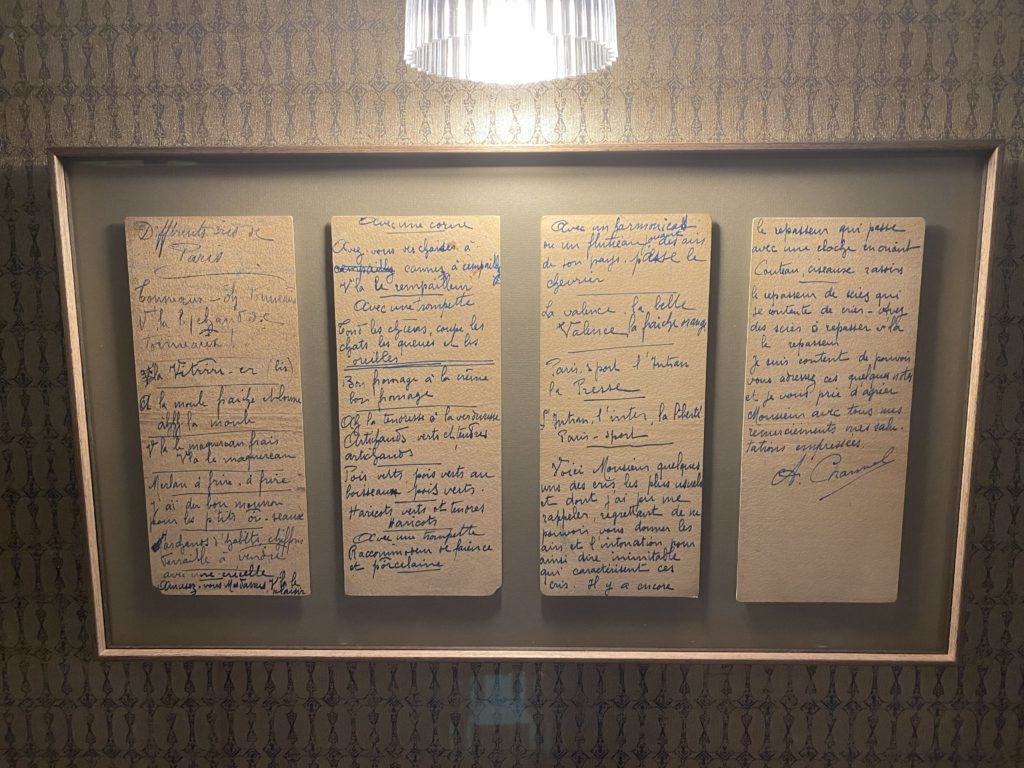


  Quant au Paris du Temps retrouvé, il ne faut pas oublier que pendant la guerre, c’est la première fois dans l’histoire qu’une ville subit un bombardement aérien. Proust est sensible aux nouveautés et à cette impression de fin du monde. Cela devient le Jugement dernier de ses personnages, au même titre que la matinée dans l’hôtel de Guermantes.


NP – Vous évoquez longuement les églises et l’un des rares actes militant de Proust qui prit leur défense dans un article. On connaît sa passion pour Ruskin et les cathédrales, dont l’architecture structure son œuvre.  

 JYT – Oui, c’est un thème capital. Certes, Proust n’est pas croyant malgré son baptême et son éducation chrétienne mais l’église récapitule pour lui tous les milieux sociaux. Il partage avec Michelet cette idée d’un peuple qui n’est pas dressé contre les élites, qui englobe toutes les couches sociales et qu’on lit sur les vitraux et les sculptures extérieures. Une synthèse du peuple qu’on retrouve dans Saint-André-des-Champs, une église imaginaire de campagne, inspirée d’après les grandes cathédrales qu’il adorait, en lisant Ruskin et en traduisant la Bible d’Amiens. Elle est une cathédrale miniature avec le thème du Français de Saint-André-des-Champs, qui est aussi bien Saint-Loup que Françoise, Théodore ou le garçon de ferme.

   L’œuvre de Proust est bâtie comme une cathédrale. Elle est à la fois une structure et un développement continu, à l’exemple de Notre-Dame de Paris, construite sur plusieurs siècles et passée d’une cathédrale romane au pur style gothique flamboyant. Proust est conscient que la structure de son roman a changé au fil du temps mais qu’il reste sacré et un. Il a une religion laïque de l’art et la cathédrale est le symbole de son œuvre, comme un temps chronologique qui juxtapose des styles différents – poétique, tragique, pittoresque -, unifié dans les phrases de Proust et des moments très différents de ton sur des sujets.

  Il a un sens sacré et religieux très important. En 1904, il écrit un article sur la mort des cathédrales pour protester contre l’idée de désaffecter les églises et les cathédrales qu’il voit comme un scandale. Pour lui, sans culte on ne peut pas croire et ces espaces perdraient tout leur sens. La lecture de la recherche du temps perdu est aussi perçue comme une cérémonie sacrée.


NP – Pourriez-vous évoquer les aspects de l’argent et de la finance et le rôle central de Lionel Hauser, son cousin et conseiller financier qui le sauve de la ruine ?

JYT – J’ai écrit deux chapitres un peu plus biographiques sur les rapports de Proust avec l’argent et la bourse. Proust était riche, non pas d’une fortune énorme mais il avait largement de quoi vivre et il était très joueur. Il jouait au Casino à Cabourg et à la bourse à Paris, de façon très sérieuse mais en se renseignant auprès de trop de gens. Il trouvait les noms des titres boursiers pittoresques, amusants ou poétiques, et ses achats se terminaient le plus souvent par des désastres. Il achetait ses actions à terme, ce qui signifie qu’on doit en régler le solde en cas de perte et il a perdu ainsi les deux tiers de sa fortune avant la guerre. Heureusement, il n’avait pas souscrit ces emprunts russes qui ont ruiné la bourgeoisie française et il réussit à vendre ses titres de mines russes à temps. Lionel Hauser était le financier de la famille pour la banque Rothschild et, catastrophé par la situation de Proust, il eut le talent de liquider à perte et d’investir dans des valeurs sûres en proposant de lui verser une rente.

  Mais Proust ne peut pas s’empêcher de lui mentir et il trouve le moyen d’acheter en sous-main ailleurs ; il connaît alors un creux terrible et il dépense beaucoup d’argent. Il joue aussi, espérant gagner pour répondre aux demandes pressantes d’Alfred Agostinelli et du jeune homme suivant, Henri Rochat, ancien serveur du Ritz devenu son secrétaire. Grâce au financier Horace Finaly, un ami d’enfance, il lui trouvera une situation au Brésil, le plus loin possible pour qu’il ne revienne pas.

  Nous allons bientôt publier aux Éditions Gallimard, grâce à Jacques Letertre, la correspondance de Proust avec Finaly. Il fut une figure importante de son époque, influent au moment du Cartel des Gauches en 1924 puis conseiller de Léon Blum sous le Front populaire. C’est sa villa de Trouville, les Frémonts, qui servit de modèle à Proust pour décrire la villa des Verdurin, la Raspelière.
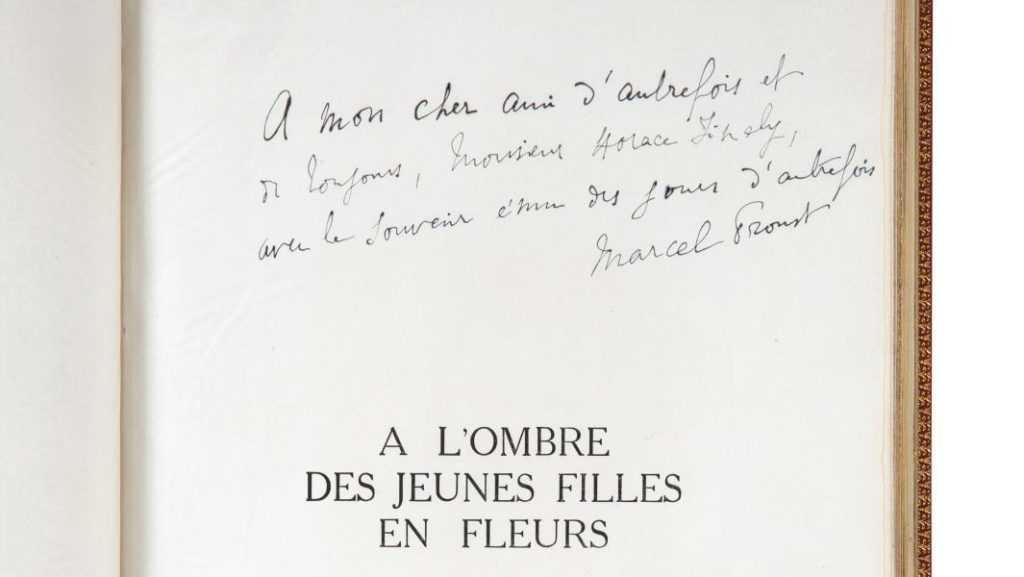


Marcel Proust (1871-1922), À l’ombre des jeunes filles en fleurs, Paris, éditions de la  Nouvelle Revue française, 1920. 


NP – Proust insiste sur les Figures de la modernité, et serait même, comme Baudelaire, un « Peintre de la vie moderne », soucieux des artistes précurseurs, des automobiles et de l’aviation.  

JYT – Proust n’est pas un homme du passé, il est soucieux de toutes les formes de la vie moderne, pas seulement pour les décrire mais en leur donnant un rôle romanesque. Il a vécu le passage de l’éclairage au pétrole puis au gaz et à l’électricité, qui sont des révolutions extraordinaires quand on les vit ! Il intègre l’avion dans son roman comme cette scène où il aperçoit un point avec Albertine dans le ciel, et il est ensuite bouleversé par la mort d’Agostinelli et le bombardement de Paris.

  L’automobile joue aussi un grand rôle avec la découverte des paysages grâce à la vitesse. Proust prend souvent la voiture pour faire des excursions autour de Cabourg. À Paris, il allait volontiers en taxi qui avait progressivement remplacé les fiacres.

  Il est un « Peintre de la vie moderne », comme Baudelaire qui lui a sans doute appris à voir cela. Proust parle volontiers de la modernité des artistes novateurs et il n’évoque jamais les conservateurs, sauf Bergotte à la fin de sa vie. Il aime le peintre Elstir et le musicien Vinteuil, qui sont des créateurs originaux, novateurs pour l’éternité. Tout comme lui finalement.

  En conclusion, je crois que Proust construit de longues phrases car ses propos englobent beaucoup d’éléments de la réalité et peuvent cacher de multiples sens. La phrase proustienne énonce un élément apparence, une réalité au-delà de laquelle il s’efforce d’aller. Il aimait cette formule : « Je sens un allons plus loin ». Et en effet, ses personnages sont aussi nombreux que tous les niveaux de sens du monde qu’il voulait décrire.


Voir les commentaires

Le mythe et le conteur

Publié le par Doctor S.F

Le mythe et le conteur
Le mythe


Au sens étymologique, mythe veut dire parole. Il est un récit fondateur dont ceux qui le rapportent avouent en être les dépositaires et pas les auteurs. C’est un récit anonyme et collectif qui remplit une fonction socio-religieuse.  Il sert le plus souvent d’élément de cohésion entre les individus d’un groupe. Le mythe met en scène des personnages le plus souvent surhumains qui ont des pouvoirs surnaturels mais aussi des comportements et des sentiments humains. Le mythe est une parole, une fable qui se réfère à des événements anciens chargés de sens : dans les sociétés primitives, il sert d’explication du monde, comment les choses ont commencé et pourquoi les hommes en sont là aujourd’hui. Il est tenu pour absolument vrai et récité dans des circonstances bien précises ce qui le distingue de la fable, du conte et toutes les histoires inventées. Dans sa composition, il est le plus souvent très court et d’un agencement parfait. Chaque détail est chargé d’une signification intense. Les sociétés industrielles l’ont relégué dans le domaine de la poésie et de l’imaginaire. Les mythes restent cependant l’expression d’une culture, ils expriment les aspirations profondes de l’inconscient humain et mettent en scène des situations éternelles. La pensée scientifique n’a pas réussi à les faire disparaître. Bien plus, dans toutes les productions littéraires se décèlent des soubassements d’images permanentes, une armature d’archétype qui manifeste sa lointaine parenté avec le mythe.

Le conte

Le conte est né de l’oubli progressif du caractère religieux du récit. Il nous introduit dans un univers enchanté dont la magie stimule notre imagination. Le conte apparaît comme le miroir de l’homme ; il dévoile ses défauts et ses haines mais il dit la force de ses idéaux. Dans toutes le civilisations, à travers les siècles, cette littérature orale se transmet de génération en génération dans toutes les sociétés. Que ce soit par la voix d’une nourrice ou celle d’un griot africain, le conte nous transmet un savoir (une initiation au monde), un espoir d’avenir meilleur car son dénouement est presque toujours heureux. Cet espoir si nécessaire à l’homme fait l’universalité du conte. Si sa forme dépend de son lieu géographique, sa matière est bien souvent la même. Merveilleux ou philosophique, le conte est une façon de voir la vie. Le conte est lui aussi un récit court qui se distingue de la nouvelle en ce qu’il n’est pas soumis aux contraintes de la vraisemblance. Il appartient à l’univers de la poésie. A partir de l’époque romantique, le conte s’est scindé en deux tendances : le registre du merveilleux et à partir du début du 19ème siècle le registre du fantastique. Le conte aime les décors fabuleux ou terrifiants. Dans les contes de fées, la magie intervient à tout moment. Ils sont peuplés de dragons, de licornes, de génies et d’elfes. Ils séduisent notre imagination mais nous ne sous sentons nullement inquiétés car d’emblée nous pressentons une dénouement heureux. Le conte nous emmène dans des contrées fabuleuses où le temps n’existe pas. Dans les contes fantastiques, l’irrationnel fait une apparition brutale dans notre univers cohérent. La mort, les fantômes, les vampires dans un climat d’angoisse font que le récit aboutit parfois à un dénouement fatal. Le rôle du conteur est de tenir son public constamment en haleine car il ne s’adresse pas à un public impassible. Il prend son auditoire à témoin, le fait se ressaisir et au besoin l’apostrophe. Il ne coupe pas le fils de son débit.

La légende

La légende - du latin legenda, choses qui doivent êtres lues - est un récit à caractère merveilleux où des faits historiques sont transformés par l’imagination populaire ou par l’invention poétique. Elle peut être crée de toute pièce par un esprit mystique ou poétique en communion avec les masses populaires : mais elle est le plus souvent l’éclosion même de l’imagination inconsciente de ces masses. Dans l’un comme dans l’autre cas, elle n’a pas cessé d’être en pleine formation parmi nous. La forme de la légende est simple et son objet d’évocation essentiel est le miracle. A l’origine, la légende racontait la vie des Saints et qui étaient lues dans les couvents. De nos jours, il s’agit plutôt de récits merveilleux d’un événement passé fondé sur une tradition plus ou moins authentique. La légende est plus soucieuse du détail que le conte.

Le mythe et le conteur

Voir les commentaires

IN SUMMER 2022 " NEW PATCHWORK " BECOMES " VIE POLYMORPHE "

Publié le par Patchwork

All works cited, described on this site are protected by the current legislation on intellectual property.

All works cited, described on this site are protected by the current legislation on intellectual property.

All works cited, described on this site are protected by the current legislation on intellectual property.

All titles and abstracts of works of authors appearing on this site as well as free downloadable E-books are protected by copyright within the meaning of article L. 111-1 of the Code of Intellectual Property.

In principle, copyright confers a private property on each owner, enabling him to determine the conditions of exploitation of his work.
Infringements of copyright are punishable by criminal law (CPI, art. L. 335-1 and L. 335-10) Infringement of copyright constitutes an infringement offence punishable by a fine of 300,000 euros and 3 years' imprisonment (ICC, art. L. 335-2 s.).
Additional penalties - closure of establishment, confiscation, publication by posting of the judicial decision - may also be imposed.


Voir les commentaires

NEW PATCHWORK 17 / LIFE IN WINTER

Publié le par Doctor S.F

" Of the grey summit of the snowy hill

We contemplated the immense white area

Of the valley of the big fleshless poplars

And high sloping roofs in the white tiles


Impressed by the hard rigor of the winter

You blotissais you under your thick white coat

And you assailed me with your soft bitter glance

Soft glance become oblique and attractive


Numb by the cold we advanced

Slowly the one towards the other one and frankly

The senses(directions) in narrow complicity of souls


Well then the winter was not any more really the winter

We forgot to look at the world

To console us with the coolness of the winter


 Coucher-de-soleil.jpg


I copied out this poem which you sent me last autumn, in answer to my letter. I may not hide you the pleasure which gets me our epistolary reunion. I know pertinently that you composed it in November, at the approach of the new season, and that you imagine that one yourself in my company. Can  you intend to mean staying at Aubel? You will see me delighted.

By the way, why I say to you "you"? After all, it is going to make on almost one year that we did not see each other any more and you will have crossed only a single night to me. Well, thus I decide to say vous you again. Your poetry seduced me and I tried some difficulty resuming some distance with regard to your text.

You so implied me there that I try some fear. For what do you thus expect from me? What are your intentions? You love me, I do not doubt it. But why did you leave so abruptly, without saying to me even goodbye?


Feel reassured, I am not irritated with it. However, to avoid some risky speculation by the truychement of such a platonic relation, I deeply prefer that you mean seeing me to Aubel. You know my address. I see no inconvenience you meaning visiting me. I am going to stay all winter long to me; so you no fear have of having; you will not find the door closed. Looking forward to meeting you very soon, I kiss you. "

I am very sad after this correspondence to understand the logic of these events which were linked of season in season, my dear Espéranza. After I told you her little common disappearance in the last spring, I wonder to announce you sincerely how this exchange. It is not the fact of making you display of our physical then virtual relations that gets me some embarrassment. Those do not prevent our friendship, naturally. And when I resumed my newspaper, the day before yesterday, to report you all which arrived at me since I met Elise Clermont in the last spring, I really understand why I made the effort to look back us on our adventure on this desert island, this summer.

Ah! The summer! The summer! What a season! Openly, I always think that the winter makes very weak face(figure) in comparison! Here is a very inferior paradox you will say to me, but it is necessary to face the evidence that it is about a season very difficult there to live. My God! I do not dare to imagine what would have been able to arrive at you over there in winter, only, lost on this island. Fortunately that the smugglers returned to it and found you, waiting in the heat of a big campfire, alone on the beach. What a jopie to know you safe! It is a real happiness! I feel a real pleasure.

Openly, I am happy to have found you both there this end of year. It is necessary to admit that these two adventures will really have been little commonplace. And what coincidences! Finally, to know you living beings comforts me, even if you are far from me. Madrid, Aubel: I wonder in this century when we live how you could indeed meet both! Anyway, you know Aubel only of name, and it is far!


   Hiver.jpg


Things being what they are, I did not still clear up the mystery of claimed disappearance of Elise Clermont. She wrote me just like that, as if nothing had taken place. Besides, she( wonders of what it took for a hasty departure. It is a very strange paradox. Openly(frankly), you will consider at me a little intoxicated, dear Espéranza, but I have difficulty in conceiving still the absurd situation that I lived with her in the last spring. However, it is bizarre, I do not dare to tell her my story. I smell good that there was been mistaken my part at some point, but it, I regret it, exceed my understanding.
Yes, I wonder when I think again about it if I do not become crazy. Fortunately that she wrote me! I tried a pleasant sensation of reassurance. But the mystery, I regret it, whole rest. I am very going to return soon to Aubel, as she proposed it to me. Then I can try to reconstitute the story in the public garden in its presence. Go, dear Espéranza, I wish you a happy New Year and good-safe a merry christmas. Bye for now!


autres-campagne-france-1248665233-1226946   


Mrs here is now on the road of Flanders, in carriage. The journey is long but tomorrow morning we shall not be any more very far from Aubel. I wrote one month ago to Espéranza and I did not see spending time. Tomorrow evening, it is safe, I shall belong to Aubel in spite of the small snowflakes which begin to fall. I am simply afraid that there is too much fog. By the way, the coachman just said to me right now that the travelers were not still safe on this road. There are naturally traffic accidents, but worse, since the beginning of the winter occurred several attacks of diligences. It is disturbing but it is necessary to exorcise the evil spell and to hope that we shall not be the next victims of these exactions so dreaded, especially in winter.


Voir les commentaires

NEW PATCHWORK 17 / THE DRUID AND THE BRIDGE

Publié le par Doctor S.F

Things being what they are, as I have the honor
To say it to you, I go, sir,
In language of real
Contesse, to try to put to sleep you
By the end of this one. You
You will thus remember, if it you
The surprise of the druid pleases,
When he lives the extraordinary bridge
That we avoit built on the riviere.

But before passing besides, it is
Good to warn you, that in the respect
Of the width of this riviere and of
The length of the bridge(deck), one you
Lied of seven or eight hundred leagues,
Both for the rarity of the fact and
For the convenience of the rhymes, and
That the Lord of Herbay, far
To be as well huge as you could
To imagine him(it) to you, étoit everything
In most that once so big and
Once so foolish as our friend S.


autres-campagne-france-1248665233-1226946.jpg

The druid, who to put sound
Castle and his daughter outside insult,
Avoit surrounded with a wide
Ditch full of water, was only surprised
When he lives the effect of a delight
Against his;
He believed to have enough to laugh
Of all the bridges and all
Giants of the world; he was only
Embarrassed to guess who could
Be the author of this bridge.

Estimating
Not enough his neighbor d'Herbay for
Consider it charming,
He hastily runs to go through his books
To clear up of the fact, and
To knock down the bridge less
Of tems that he had raised:
But when all the books that he
Opened taught him nothing, it  was
In a big embarrassment; embarrassment
Which is converted in a sadness
Strange, when he lives that he cherchoit
Pointlessly the one who contenoit
All the secrets of his art.
It  defended the reading in his
Girl, to whom he never had anything
Defended that it, and some soûmise
That she had always be in her
Wills, he was afraid that the curiosity
For a matter expressly
Forbidden, had taken him
On his obedience. It was in
These allarmes that he found her as is
That we left her.

He awakened her
Quickly to ask her
Short stories of this book
If need be her intentions: but
It was to teach it to her indeed
Others than she spoke. Of
The maniere of which she came of
Fall asleep, I would have sworn that in sound
Awakening she went address in
Druid, by saying to him: big commander
Believer but
Her distraction changed object,
And throwing in her foot : my father,
She says, I lost him, and if you
Return it to me, you will see me
Die from despair, because it is
More tems to hide my foiblesse,
Nor to hide my murder. Yes
I lost it . what! Exclaimed
Druid, not only, Girl,
You broke me: but you
Lost what was me most
Dear to the world after you!

Voir les commentaires

NEW PATCHWORK 16 / LIFE IN AUTUMN

Publié le par Doctor S.F


Autumn, 1869, October: I three times went to the toilet for this morning of October 4th, 1869. I do not know what arrives at me but I have the impression that there is not season anymore since I am locked into this room in walls papered with books. I am more than a week in search of a text which would have been written by the father of Elise Clermont: he would explain his mysterious disappearance to the public garden of Aubel. I may not refrain from keeping rehearsing the little common event which I lived over there in the last spring. I have a headache and I have a great deal of difficulty in admitting still my presence between these four walls of the library of professor Stévenard. Why this stubbornness to be tried to find the theoretical explanation of a fact certainly little common but on the whole rather harmless.

Go, I have to regain self-control. I am not all the same going to spend one week more to go and to come between this library and my place of residence, situated two floors above the apartment of the professor. When I rethink about it, this disappearance seems to me finally so absurd as I wonder if it is not about a pretext for my unconscious, always in search of the shape of its body, its hair so soft, its bosoms so ripe, its triangle so attractive there. Here is more than seven months than I did not see again her any more and I still wish it. More than her being, it is the ecstasy of the senses that it gets me which misses me a lot, in the point to understand this strange and sneaky coalition of the physical and moral pains which torment me.


I have just discovered a very former work on of distant expeditions in the Pacific Ocean. The book is very damaged, so that we cannot find the date of publication there. But he has to date the last century. He has to involve a very dark edition. But the work interests me because it evokes among others Tarawa, Aurorae. Yes, but I can hardly hope of explanation as for this mysterious ilôt on which we failed, Espéranza and I, last summer. It is low there that I lost her. I lost her, for ever.


Fortunately that a boat will have accosted a few days after its disappearance in this jungle there. It is thanks to these misled smugglers that I was able to get back to India. Certainly, I shall have made everything to find her. It will have been very difficult to me to explain to these unkind sailors the reason of my stubbornness to retain them on the island. I used some gold louis which still stayed in me of our wreck to buy their expectation. But they refused of entreprendre searches with me. So I shall not hardly have been able to make more than to switch on a big fire on the beach, and to maintain it during almost two whole days. In any logic, Espéranza should have gone raised on the rocky headland, which down from the clearing dominated almost all the island. Then, forced to climb it at the moment or to the other one, she would necessarily have seen the noiret smoke turning, she would have understood that she came from the beach!


 But not, I shall have crossed about two days to maintain the fire(light), to shout each one more than the other, to try fast and adventurous excursions in this endless mess of coconut palms and gigantic vegetation, and I was able only to make me obviously the most painful: Espéranza had disappeared. Moreover, it is the leader of the smugglers who will have put out the fire himself. Heprovoked me in duel with the cutting weapon, then persuaded that my story had no sense and that I made him waste his time. Not thinking more than of saving my skin, I had to wipe a bad stab which will have plunged me into a comatose state. However they will not have abandoned me because they put to sleep me for all the crossing: then I woke up first morning from the autumn on a quay of Calcutta, in India. There was not more than to return to Europe. As the smugglers had deprived me of all the gold which stayed in me, I understood that they had had to leave not enough time.


I went out for some minutes. I believe that I am going to stop this stupid research; she taught nothing to me. I shall have gone through several works on the islands of the Pacific, I shall have leafed down encyclopediae, among which that of Diderot, but it was of use to nothing. It is not certainly with the treaty at the time or the reflections on the space that I am going to succeed in discovering the truth as for the strange disappearance of Elise Clermont to Aubel. However, I understood that I continue to reflect about it, at the moment even where I look at the dead leaves which sprinkle the path of the park, behind the building. The weather is rainy. The sky darkens again and I cannot linger any more. I decide to abandon the library of the professor and to return at home.


 As usual, I get back my mail in the mailbox at the ground floor then borrow the staircase which leads to my third floor. I open automatically the front door, put my mail, my documents. Suddenly, I remain motionless, eyes riveted on an address written in the back of the white envelope which I just got back right now. This writing says to me something. Then, stuns, I read the address: " Elise Clermont, square Albert I °, 4880 Aubel ". Taken by a sudden passion, I nearly cut the index with the paper knife. Very fast, the reading of some written sentences hastily make me resume consciousness of the reality.

" Dear Nestor,

While maintaining month I did not write to you any more and you have to find that time passes slowly since our

Meeting to Aubel. I was surprised with your hasty departure. I tried some regret.

But as we knew recently, I supposed that you are not any more interested in me and that you had not thus made the effort to leave.

However, I found your address on a former(ancient) pad. As the autumn season leaves me the time, I write you these some words, in the hope of you to see again maybe a day. "


Voir les commentaires

NEW PATCHWORK 15 / LIFE IN SUMMER

Publié le par Doctor S.F

We were lengthened on the sand. Our arms seemed flasks, our dead bodies. The salt water licked our feet and ventured up to the thigh. The sky seemed clear. An impressive silence reigned over this beach.

Suddenly, a crawling insect risked beginning a gratitude on its body. I woke up slowly, moved by the pleasant vision of the shape of its feminine body. I tried to get up but a pain stopped me. I had a headache, I was thirsty. So much salt water and no drinkable drop! How had I arrived there? Why was not I in the bungalow? Then the memory returned to me.

We had left for an aimless expedition really precise. The storm. Yes, I still remembered these atrocious minutes. I was wrinkled on the vermoulu wood. The hull had split. Then, we had caught a branch of tree resulting out of nowhere. We had had to strike a rock. But how we did not have been able to see this island while she.


    2007-0701_s2_.jpg


I got up, manage to stand me. I made some steps. The map, the fisherman. The authorities of Tarawa had also been formal. There was no island, no atoll from Aurorae, it on a distance far too important to have been crossed(gone through) in three quarters of an hour! I believed to penetrate into the unreal, the dream.

How this island, because it was one, did she have been able to escape the geography? No, it was not possible. Nevertheless, this offshore journey, this expedition on the speedboat, I had made it. Unless... No, it was inconceivable. We were too much far from Aurorae. My throat was formed.

The voice of my friend came to put an end to my breathlessness of fear. Espéranza was there, next to me. We exchanged a glance. Espéranza looked at her watch: she had resisted. It was the proof that we had not really had to be far from the island.


I showed the gigantic coconut palms which surrounded the beach. We advanced unanimously and penetrated a kind of very narrow path trained by ramparts of interlaced plants. A clearing opened abruptly to us. Being afraid of misleading us, we turned back. The island was big, immense. Here is who still added to the unreal of the situation.

When we had returned on the beach, we had to face the evidence: the island was uninhabited by the man. There was certain number of animal species but no track of human presence, not the slightest construction of fortune. The island was completely subjected to the nature.

We so spent our first hours of solitude based on the warm sand, in front of the sea. That one held(retained) us prisoners. What a strange situation! However, we were not the only ones to have disappeared offshore. Although disturbing, ours would amaze hardly our contemporaries, moreover more worried by the current events


I struck the sand with rabies and resentment. My foot struck some pebble, then bled. I sat down again, looked for my handkerchief. I noticed at the same time as I had no more my knife. Then, I crawled up to the salt water and dipped the foot there. I sentai the salt be tormented the wound, to penetrate in the depths of the flesh. But my grandmother always said to me that it was a good healing product. However, I so had pain. Besides, I had lost my knife. I was plunged into the biggest confusion. Espéranza says word. She understood.

Suddenly, the young woman got up, made some steps, then decided to try only a new gratitude(recognition) in the surroundings. From my part, I had found nothing better than to look at the sea. I had this strange impression(printing) that a hostile atmosphere began to get free of these more and more shaken streams. It had been a long time since Espéranza had left. The love which I began to feel for her made quaiguiser this deaf person frightens.


I scrutinized of a worried eye impenetrable rampart of coconut palms and interlaced lianas. Suddenly, I perceived some smoke which escaped from the greenish mass. Then, I feared the worst. Decided, I advanced so-so in this sort of jungle. Guided by the volutes of smoke outlines of which became clearer little by little, I reached a source having hesitated for a long time between two paths. She made sink a crystal clear water. I could not resist to the temptation to drink some mouthfuls, so much I was thirsty. Then straightening me, I scrutinized the surroundings of an eye sharpened by the strange atmosphere which reigned at this precise moment.


    wp19d5643f.jpg


Suddenly, my glance returning on rocks, I gave a cry of bewilderment. In the hollow of a cavity in the stone was my knife put on a small silk material scarlet. It was some blood, some dried blood, and there was a lot. My emotion was for its height. I felt an unspeakable fear. This pût-il whether it is the blood of my friend? I had then the bizarre feeling to live the loss of this blood. If it was good his, as I anticipated him(it), it was little as if it was mine which had poured. At the same time as the pain became more marked increased my love for my princess become the prey of some dark force and malefic.

I seize the knife with precaution then tried to estimate the distance which separated the cavity of the summit. I climbed the rock face with precaution, raised myself up to the summit, then looked, eyes were bothered by the sun. An immense luxuriant area of trees and creepers occupied the quasi-totality of the surface. But the rock was not high all the same enough so that I am capable of distinguishing the precise limits of this small plant empire. I wanted to distinguish again this smoke that I had just seen right now but there was nothing more. It is necessary to say that with the incident of the knife, I had lost a lot of time.

I got down again. I scrutinized the sky of a worried eye, being afraid that the sun not already couchät. But the day star always spread its heat. His(her,its) light produced reflections of emerald on the wave-like water. I had no more notion of time. And I met alone. No piece of short story of Espéranza and the sunset was not any more going to delay now.


Would they be condemned to live here? No, thought Espéranza, no. It was necessary to regain self-control, not to be allowed abandon(give up) in the discouragement or in the laziness which watches for everything to be isolated by the world. The risk of marginalization that would make them run(roam) in a inexorable way the passivity in front of an insoluble problem was too heavy. No, you should not resign itself, it was necessary to take out from there. But how? The night was already fallen, weakly lit by a small crescent moon.
 She( remained, based, sluggish there, knowing how to only make. She remembered itself these hours crossed to try to find this endless path with which " expedition of gratitude ", and then this source, and brutally this panic fear had begun his(her,its) who seized her. She began roaming, running, and stopped only out of breath, exhausted itself, plunged into the deepest exhaustion, holding out the hand towards her rescuer, whom she believed to see, such a hallucination. But I was not there and my absence was only increasing her love in the pain.

I released(left) a sigh, put my head on my knees, then observed the merry-go-round of some carrier insects of microscopic food. I remembered myself the moment of our meeting, in Europe, around of London. Very common, that one had nevertheless left in my memory an unforgettable memory. We had not confided our love yet, but the meeting had brought us to decide on this journey for the Pacific. Originally, I would have preferred that we stop in India, in Bombay. Moreover, we stayed there one week. But as we had time, she preferred to pursue our pleasant very far journey, up to the islands of the Pacific, there where the French colonists have some counters. I thus followed her, doubting me that its tourist interest was not deprived of some love for me.


    prochester1_s2_.jpg


Everything was quiet and dark. What arrived at me with my new friend called back me practically since her absence bothered me the disappearance of Elise Clermont in the last spring, in a public garden to Aubel. I did not see again her any more since, the door of its apartment of the placeAlbert I ° remaining irreparably closed in each of my attempts of visit. At the time of embarking for Bombay, the wearing tide was always without piece of short story of this reported missing person.

No, no, it was impossible that the fate is such as I vécusse a new disappearance without being able to make whatever it is. I had to put an end to the feelings which assailed me. I had no more notion of time but I knew that the night would soon be ended. I was a little going to sleep and from the sunrise, I would go back up on the rock to scrutinize the horizon. Espéranza would have certainly the idea to light a fire. I could so turn. Well then I shall find her.


Voir les commentaires

NEW PATCHWORK 14 / LIFE IN SPRING

Publié le par Doctor S.F

Everybody knows that almond trees bloom in spring. Some know that the revolutions are about born in this period of the year. But who knows in this city what arrived at Elise Clermont? Imbecile question I said myself. Nevertheless, to think about it well, I have the impression that the parallel is not ridiculous when I keep rehearsing these memories which haunted my nights of teenager, before I leave to the war to forget everything.


This memory nevertheless turned out in time immortal and I realize by writing you that I always saw inside my being the same strange, unusual sensations. I do not manage to forget what arrived at Elise Clermont to spring, 1869. It seems to me even so improbable as I wonder why and how I am well to be able to tell you what took place in its apartment of the square Albert Ier to Aubel, on April 15th, 1869.

This morning there, she had got up very early and had had breakfast only, letting me sleep in her guest room. She had then made a walk along the public garden, still closed at the present time there. The street was deserted and darkened by the sky, which the brightness of the rare streetlights succeeded hardly in qualifying. She had since the railings of the garden open then she had gone to sit down on a bench, in the shade of a troop of almond trees in flowers.


The garden was still abandoned and Elise Clermont was allowed rock by some dark musing. She felt rather good when I approached him. She realized my presence on the bench, next to her, only having heard a shot which made her go out of its bliss. She snuggles up to me, her senses on the alert, the misled glance. There seemed be still nobody in this garden and the sound had nevertheless been so close. I did not dare to get up, thinking of protecting Elise who well needed it.

Suddenly, she got up with some strange violence which left me stunned. She ran in the direction of the small pond, in the middle of the garden, so that she could not be seen by whoever. I did not understand her reaction, obviously. Release itself from what she could conceive as my influence could get. But to rush so to the danger seemed to me unreasonable. Openly, I was very afraid for her. Who says that the shot had not been pulled inside the public garden?

    the-london-eye_mini.jpg

Naturally, I did not remain for a long time sat, and I rushed in my tour to the pond, thinking only of saving the one that I estimated to be my future soul mate. However, same mid-term step, I already felt a pleasant reassurance, understanding that nothing took place, because I heard nothing. It had to make now one quarter of an hour which the shot had rung. If he resulted from the outside from the garden, as I suppose it, maybe it was the fact of some walker at a loose end, or then somebody will have fired through an opened window.

It is a fact that there was a moment when we had not heard any more shot in the district since constabulary had intervened to release a young man taken hostage by a bandit. But I put practically at once a term in my deductions to face the evidence: Elise was not there. I sat down then at the edge of the pond, embarrassed by the contradictory feelings which had invaded my spirit.

I began crying. Why had Elise left as it? All right, there had been a shot, it had not been very pleasant and even if a symbol of the war can have something romantic, it did not please me. Not openly, this morning there, with Elise Clermont, I wanted to spend an intimate moment, quite printed by sweetness and by delicacy, my hand caressing slowly the fold of its silk dress, touching the skin up to the breast, with the aim of embracing her and feeling her body squeezing up against mine.

I liked too much Elise Clermont's fragrance to forget it. And even after the war I still remember it myself. It got me an unforgettable sensation of exoticism, little as an unknown flower which my eyes could not discern within the plethora of floral species which I had been able to see to there. Really, more than her fragrance , I loved Elise Clermont. I was desperately in love with it, and it since the beginning of this spring, 1869.


Ten minutes had just passed by since I had noticed her improbable disappearance. She had gone well and truly to the pond, in the middle of the public garden. I had seen her. No, she had not taken the direction of the unique exit that the railings of the garden offered to the users. Maybe she was hidden behind a tree, or a copse. But it was not all the same any more a kid. She was not either of the genre to climb on trees or to climb the fence. No, if she had wanted to go out, she would naturally have taken the direction of railings, which she knew opened. Anyway, she knew too well the public garden and could not make a mistake about direction.

But now, it was almost ten o'clock, it was daylight and some curious onlookers approached me. I had the bizarre impression that these people there wanted me something but I did not know them: I had never met them. They stopped a few meters away from me, as to stare at me. It got me a real sensation of embarrassment and the sensual pleasure which I had felt in the thought of Elise right now had completely disappeared. But fortunately, these people boldly resumed their route, which I did not miss to wish them unpleasant.
 

    boatsunsetframed_s2_.jpg


However Elise Clermont was absent. I was now certain that she was not in the public garden at the moment when I observed the perspective of trees aligned on both sides by the path leading to railings. Seeing the walkers becoming more and more numerous, I decided to leave the place and to turn to the apartment of the square Albert Ier. Then returned in me the desire of her body, sound to be which spread so much my senses. I remember myself too much first day of this spring, 1869 when I met her.

The meeting took place in the same public garden, on the same bench where we sat at the very beginning of the morning. She was calmed by some musing when I approached it, attracted by her soft fragrance printed by exoticism. I sit next to her and we stayed there ten minutes silently. She did not look at me and I did not dare to look at her. Suddenly, she asked me for the hour, with a small accent of the South of France which was not to displease me. I gave her happy of the pretext that it was given to me to engage with her a small conversation.

    images2.jpg

But curiously, she seemed not to want to go farther, even not thanking me. However, she remained sat next to me. I did not dare to get up. It was not the punishment because I had to make nothing this morning there. No, I did not want to leave. She was, next to me, immovable and silent there. Nevertheless, the sky made threatening. I indeed saw smoothing some black clouds. I had perceived in front of the bench a small roaming cat the leg behind the head. It is harmless but it seems that cats so behave when it is going to rain. The thunderstorm announced and I shivered with it of fear.

The atmosphere had become lugubrious. I decided to leave when the hand of the girl held(retained) me by the arm, so that I was obliged to sit down again. I say word and was allowed make, the hand beginning to caress me slowly, with discretion, everything in delicacy. The more the thunderstorm made threatening, the more the pressure of her body against mine became intensified. An intense pleasure invaded my whole etre. My senses on the alert had entered communion with his. We had forgotten everything around us and the first rainy gouts did not succeed in breaking the carnal link which united us. It is only when the first thunderclaps rang that we decided to leave the place. And it is arm in arm that we gained her apartment of the square Albert Ier.


Voir les commentaires

NEW PATCHWORK 13 / TIT-COQ

Publié le par New Patchwork

 Théâtre

A propos du Tit-Coq de Gratien Gélinas

Gratien Gélinas est l'auteur de Tit-Coq, pièce de théâtre parue aux éditions Beauchemin de Montréal en 1950. Tit-Coq a été joué pour la première fois le 22 mai 1948 sur la scène du Monument National, à Montréal, dans des décors de Jacques Pelletier, des costumes de Laure Cabana et d'après une mise en scène de l'auteur en collaboration avec Fred Barry. Après la relâche d'été, la pièce continua sa carrière au Théâtre du gesu, où la deux centième représentation fut donnée le 22 mai 1949.

Tit-Coq fut le premier grand succès du théâtre québécois. Le public reconnaissait la voix privilégiée de l'âme collective de ce peuple francophone dans ce personnage à la fois témoin des peurs engendrées par la guerre et défenseur de sa culture.

" Tit-Coq est l'une des œuvres les plus originales et les plus poignantes du théâtre moderne. Il y a des moments qui sont d'une tendresse exquise ou d'une violence terrible, ou d'une gouaille plus terrible encore, souvent qui sont tout cela à la fois, des moments qui ont fort peu d'égaux sur la scène contemporaine."

René Lévesque, Le Clairon

" Tit-Coq a vieilli, bien vieilli, comme un meuble d'époque, rustique, authentique. On relit la pièce avec intérêt. Sans doute faut-il maintenant la resituer dans son contexte: la guerre et ses séquelles [ … ]. Les conflits localisés et datés de Tit-Coq ont une signification historique. On pourrait revoir la pièce à la lumière [ … ] d' Un simple soldat de Dubé, dont le héros-victime a plusieurs traits de Tit-Coq: mi-orphelin, mi-révolté, etc. Tit-Coq a maintenant une postérité et un nouveau contexte."

Laurent Mailhot, Présentation critique à l'édition de Tit-Coq, Quinze, 1980


Voir les commentaires

<< < 1 2 3 4 > >>